Smart Shades for Energy Management: A South Florida Homeowner’s Guide
Learn how smart shades support energy management, comfort, privacy, and light control in South Florida homes—and how to choose the right automated window treatments.
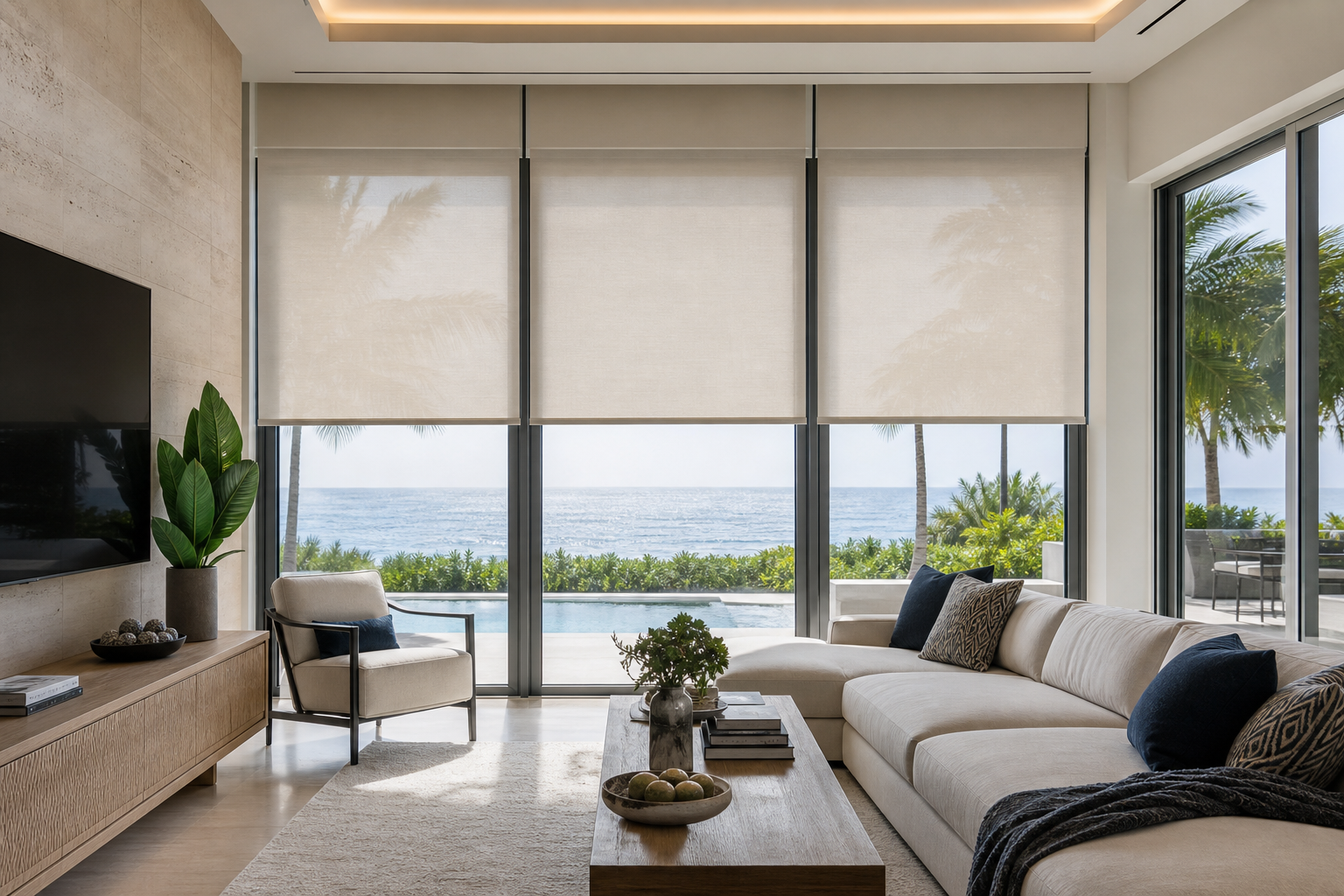
Smart shades for energy management can help South Florida homeowners manage intense sunlight, indoor temperatures, glare, and privacy more conveniently. Instead of adjusting every window by hand, motorized shades can be scheduled or controlled through a remote, app, or compatible smart-home system.
Automation is only one part of an effective window treatment solution. The shade style, fabric openness, color, window orientation, fit, and daily schedule all influence how well the system supports comfort and light control. This guide explains how smart shades work, where they can help most, and what to consider before choosing a system for your Miami-Dade County home.
What Are Smart Shades?
Smart shades are motorized window treatments that can be raised, lowered, or adjusted without manually operating a cord or chain. Depending on the system, homeowners may use a remote control, wall switch, smartphone app, timer, or smart-home integration.
Smart shades are available in several styles, including roller shades, solar shades, blackout shades, and zebra shades. Each style offers a different combination of light filtering, privacy, insulation, and design flexibility.
For example, solar shades can help soften glare and filter daylight while maintaining a view, while blackout shades are designed for stronger room darkening. Zebra shades provide alternating bands of sheer and opaque fabric that can be adjusted for changing levels of light and privacy.
How Smart Shades Support Energy Management
Window treatments do not generate energy or replace air conditioning, but they can help manage the amount of sunlight entering a room. In South Florida, that matters because direct sunlight can increase glare and contribute to heat buildup near windows.
Reduce direct solar exposure
When shades are scheduled to lower during the brightest part of the day, they can block or filter some of the sunlight entering through the glass. This may help rooms feel more comfortable and reduce the need to compensate for glare with additional cooling or artificial lighting.
The result depends on several factors, including the window’s direction, the type of glass, the shade fabric, and how closely the treatment fits the opening. West-facing windows often deserve special attention because they receive strong afternoon sun, while east-facing windows may need morning protection.
Manage heat and glare together
Heat and glare are related, but they are not the same problem. A room may be bright and uncomfortable because of direct sunlight, even if the temperature is not significantly higher. Solar shades are often considered for spaces where homeowners want to reduce glare while preserving an outdoor view. More opaque fabrics may be preferable when stronger light control and privacy are priorities.
Automated scheduling makes it easier to respond to predictable sunlight patterns. Shades can be programmed to close during peak exposure and open later when the light is softer, helping homeowners avoid leaving treatments in one position all day.
Support more consistent indoor comfort
Large windows, sliding glass doors, and rooms with high ceilings can be especially challenging to manage manually. Smart shades can coordinate multiple windows so that treatments operate together. This is useful in open-concept living areas, bedrooms with several windows, and homes with expansive views.
A professional consultation can help determine whether one shade type should be used throughout a room or whether different treatments are better suited to different exposures.
Smart Shade Features That Matter
Not every automated shade system provides the same experience. When comparing options, consider the following features.
Scheduling
Scheduling allows shades to operate at selected times of day. A homeowner might create a morning setting that opens shades gradually, a daytime setting that lowers treatments on sun-facing windows, and an evening setting that increases privacy.
Schedules should be practical rather than overly complicated. They may need to change seasonally because sunrise, sunset, and the angle of sunlight vary throughout the year.
Group control
Group control allows several shades to move together. You may want all the treatments in a living room to operate as one group, while bedroom shades follow a separate schedule. This can simplify daily use in homes with many windows.
Manual override
Smart automation should not make a room difficult to use. A remote, wall control, or app-based manual override allows you to change the shade position when conditions or preferences change.
Smart-home compatibility
If you already use a smart-home platform, ask which control methods are supported by the shade system under consideration. Compatibility can vary, so it is important to confirm the available options before ordering.
Quiet, reliable operation
Motorized shades should fit naturally into daily life. Quiet operation is particularly valuable in bedrooms, home offices, media rooms, and spaces where frequent movement could be distracting.
Choosing the Right Shade Style for Energy Management
The best automated shade is not necessarily the same for every room. Consider the room’s purpose, exposure, privacy needs, and desired appearance.
| Shade style | May be a good fit for | Key considerations |
|---|---|---|
| Solar shades | Living rooms, offices, and view-oriented spaces | Helps manage glare while maintaining some visibility to the outside, depending on fabric selection |
| Blackout shades | Bedrooms, nurseries, media rooms, and guest rooms | Useful when stronger room darkening and privacy are important |
| Roller shades | Many rooms and modern interiors | Available in different fabrics and openness levels for varied light-control needs |
| Zebra shades | Living areas, bedrooms, and contemporary spaces | Adjustable bands provide flexible transitions between filtered light, privacy, and a more open view |
Motorization can be added to several shade styles, but the fabric and design still determine the underlying light-control performance. A professional recommendation should account for both the automation and the window treatment itself.
South Florida Window Considerations
Homes in Miami, Kendall, Doral, Coral Gables, Pinecrest, Miami Beach, and nearby communities often have large windows, bright interiors, and strong connections between indoor and outdoor spaces. These features are attractive, but they can also create challenges with sunlight, privacy, and comfort.
Window direction
Identify which windows receive the most direct sunlight and at what time of day. This helps determine which openings need scheduled shade movement and which may only require occasional adjustment.
Large windows and sliding doors
Wide glass areas can be difficult to cover evenly with off-the-shelf products. Custom shades are measured for the specific opening and can be coordinated across multiple panels. This is particularly important when consistent alignment and a clean appearance matter.
Privacy after dark
During the day, bright outdoor conditions may provide a degree of privacy. At night, interior lights can make it easier to see into a home from outside. Smart shades can be scheduled to close in the evening or grouped with other window treatments for a consistent privacy routine.
Indoor-outdoor living
For homes with patios, porches, or large openings to outdoor areas, interior shades may work alongside patio screens or outdoor screens. Interior shades help manage indoor light and privacy, while outdoor screens can make exterior living areas more comfortable. These products address different parts of the home and should be selected according to the conditions each space experiences.
How to Plan a Smart Shade System
- List the problem windows. Note where glare, afternoon heat, fading concerns, or privacy issues are most noticeable.
- Identify your daily routine. Consider when rooms are occupied, when sunlight is strongest, and when privacy is most important.
- Choose the desired light level. Decide whether you want filtered daylight, a maintained view, adjustable privacy, or stronger room darkening.
- Group windows by function. Windows in the same room may not all need identical settings. A consultation can help determine whether they should operate together or separately.
- Review control preferences. Decide whether you prefer a remote, wall control, app, scheduling, or smart-home integration.
- Schedule professional measurement. Accurate measurements help ensure the shades fit properly and operate as intended, especially for wide windows, specialty openings, and multiple-window installations.
Why Professional Measurement and Installation Matter
Motorized window treatments combine a precise fit with a powered operating system. Incorrect measurements can affect alignment, coverage, and the overall appearance of a room. Installation also needs to account for the window opening, mounting surface, shade width, and access to the controls.
Professional guidance is especially useful when a home has high ceilings, large expanses of glass, multiple rooms, or a mix of shade styles. You can learn more about related planning considerations in this South Florida guide to window treatments for high ceilings.
A custom consultation also helps connect design decisions with practical goals. Fabric color, openness, opacity, and mounting style all affect how the finished shades look and how they perform in the room.
Common Mistakes to Avoid
- Choosing based only on motorization. Automation is convenient, but the fabric and shade style determine much of the light and privacy performance.
- Using one setting for every window. South- and west-facing windows may need different schedules from shaded or north-facing openings.
- Ignoring nighttime privacy. Daytime visibility and nighttime privacy can be very different, especially in brightly lit rooms.
- Skipping professional measurement. Small fit issues can be more noticeable when several shades are installed side by side.
- Overcomplicating the schedule. A simple routine that matches how you use the home is often easier to maintain than many separate rules.
For more guidance on selecting treatments for strong Florida sunlight, see this guide for Pinecrest homeowners.
Frequently Asked Questions
Can smart shades help lower energy use?
Smart shades can help manage sunlight, glare, and heat entering through windows, which may support more comfortable indoor conditions. Their effect on energy use depends on the window, shade fabric, orientation, home construction, and how the shades are programmed. They should be viewed as one part of a broader home comfort strategy.
Do smart shades work without a smart-home system?
Many motorized shade systems can be operated with a remote or wall control without requiring a full smart-home system. Available control options vary, so discuss your preferred setup during the consultation.
Are smart shades suitable for bedrooms?
Yes. Motorized blackout shades can support a darker, more private bedroom, while scheduled operation can open the shades in the morning without requiring manual adjustment. The appropriate style depends on your preferred light level and design.
Can different shade styles be used in the same home?
Yes. A home may use solar shades in a living room, blackout shades in bedrooms, and zebra or roller shades in other areas. Controls can often be organized by room or function, subject to the system selected.
How do I know which windows should be automated?
Start with windows that are hard to reach, receive strong direct sunlight, create glare, or need frequent privacy adjustments. High windows and large glass doors are also common candidates for motorization because manual operation may be inconvenient.
Plan Smart Shades for Your South Florida Home
Smart shades for energy management can make it easier to respond to South Florida sunlight while improving everyday convenience, privacy, and design consistency. The most effective solution starts with a room-by-room assessment of window exposure, light-control goals, and how you use the space.
Floridian Blinds can help you compare motorized roller shades, solar shades, blackout shades, and zebra shades for your home or property. Contact us for a free consultation and measurement to discuss a custom window treatment plan for your needs.